
Laravel Observer vs Listener: Real Differences with Practical Examples
Laravel developers often get confused between Observers and Listeners.
And honestly… that confusion is completely normal.
Because both are powerful. Both react to events. Both help automate logic. And both help keep controllers clean.
But internally, they solve very different architectural problems.
Once you truly understand where each one should be used, your Laravel applications become:
- Cleaner
- More scalable
- Easier to maintain
- Better structured
Good architecture is not about writing more code.
It’s about writing smarter code.
Why Understanding Observer vs Listener Matters
In small Laravel projects, developers often place everything inside controllers.
Initially, it works fine.
But as the project grows:
- Controllers become massive
- Business logic gets duplicated
- Code becomes difficult to maintain
- Scaling becomes painful
This is exactly where Laravel’s Observers and Listeners help.
They allow developers to build clean, modular, and scalable applications.
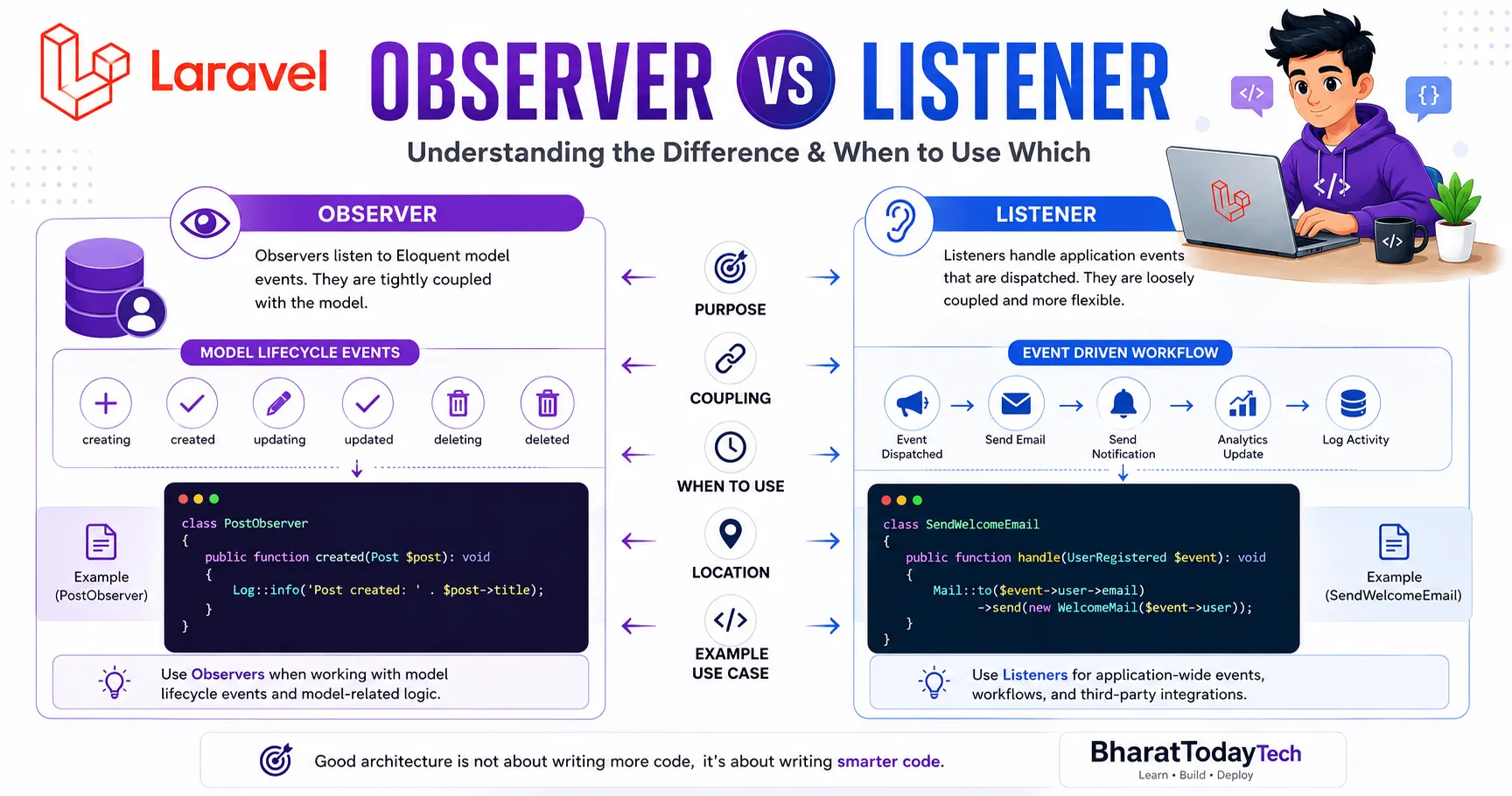
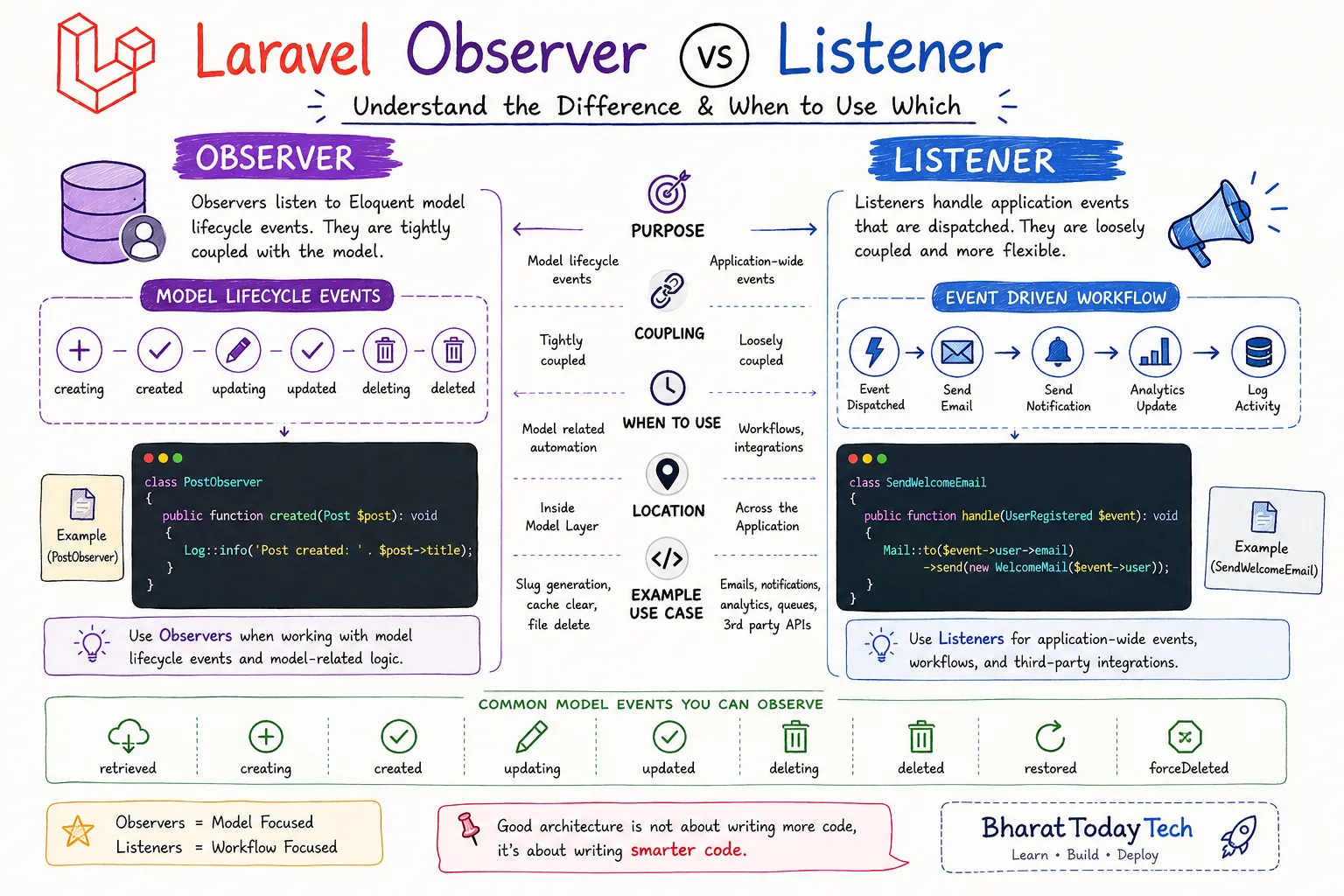
Quick Difference Between Observer and Listener
| Feature | Observer | Listener |
|---|---|---|
| Main Purpose | Handles Eloquent model lifecycle events | Handles application-wide business events |
| Coupling | Tightly coupled with model | Loosely coupled architecture |
| Best For | Model-related automation | Workflows & integrations |
| Examples | Slug generation, cache clear | Emails, notifications, analytics |
What is an Observer in Laravel?
Observers are classes used to listen to Eloquent model lifecycle events.
Whenever something happens to a model, Laravel can automatically trigger Observer methods.
Common model events include:
- creating
- created
- updating
- updated
- deleting
- deleted
- restored
Observers are tightly connected to models.
That means they are perfect for logic directly related to model behavior.
Real Project Example: Blog CMS
Suppose you are building a blogging platform like Medium or BharatTodayTech.
Whenever a post gets created, you may want to:
- Generate SEO slug
- Create excerpt automatically
- Generate reading time
- Clear related cache
- Create activity logs
This logic directly belongs to the Post model.
So using an Observer makes perfect sense.
Create Observer in Laravel
php artisan make:observer PostObserver --model=Post
Observer Example
namespace App\Observers;

use App\Models\Post;
use Illuminate\Support\Str;
use Illuminate\Support\Facades\Cache;
use Illuminate\Support\Facades\Log;

class PostObserver
{
    public function creating(Post $post): void
    {
        $post->slug = Str::slug($post->title);

        $post->excerpt = Str::limit(strip_tags($post->content), 150);
    }

    public function created(Post $post): void
    {
        Log::info('New Post Created: ' . $post->title);
    }

    public function deleted(Post $post): void
    {
        Cache::forget('latest_posts');
    }
}
Register Observer
namespace App\Providers;

use App\Models\Post;
use App\Observers\PostObserver;

public function boot(): void
{
    Post::observe(PostObserver::class);
}
What Happens Internally?
Now whenever this code runs:
Post::create([
    'title' => 'Laravel Observer Guide',
    'content' => 'Observer content here'
]);
Laravel automatically:
- Calls creating()
- Generates SEO slug
- Creates excerpt
- Saves record
- Calls created()
- Writes logs
This keeps controllers clean and reusable.
When Should You Use Observers?
Perfect Observer Use Cases
- SEO slug generation
- UUID generation
- Activity logs
- Cache clearing
- Deleting uploaded files
- Generating excerpts
- Auto timestamps
- Maintaining audit history
What is a Listener in Laravel?
Listeners are part of Laravel’s Event System.
Instead of listening directly to models, Listeners react to application-wide events.
This creates loosely coupled architecture.
And honestly… this becomes extremely important in large applications.
Real Project Example: User Registration Workflow
Suppose a user signs up on your application.
After registration, you may want to:
- Send welcome email
- Create wallet
- Send admin notification
- Trigger analytics
- Send WhatsApp message
- Start onboarding workflow
Putting all this logic inside the controller becomes messy very quickly.
This is exactly where Events & Listeners become powerful.
Create Event
php artisan make:event UserRegistered
Create Listener
php artisan make:listener SendWelcomeEmail
UserRegistered Event
namespace App\Events;

use App\Models\User;

class UserRegistered
{
    public function __construct(
        public User $user
    ) {}
}
Listener Example
namespace App\Listeners;

use App\Events\UserRegistered;
use App\Mail\WelcomeMail;
use Illuminate\Support\Facades\Mail;

class SendWelcomeEmail
{
    public function handle(UserRegistered $event): void
    {
        Mail::to($event->user->email)
            ->send(new WelcomeMail($event->user));
    }
}
Dispatch Event
event(new UserRegistered($user));
What Happens Internally?
When the event gets dispatched, Laravel automatically executes all connected listeners.
That means:
- Emails can run separately
- Notifications can run separately
- Analytics can run separately
- Queue jobs can run separately
- Third-party integrations remain isolated
This makes applications highly scalable.
Real eCommerce Example
Imagine a real eCommerce application.
When an order is placed, multiple actions happen:
- Inventory updates
- Invoice generates
- Email sends
- Warehouse notified
- Reward points calculated
- SMS sent
- Analytics updated
You definitely don’t want all this logic inside OrderController.
Listeners help split responsibilities cleanly.
Observer vs Listener in Simple Language
Use Observer When:
- Logic belongs to model lifecycle
- Working with Eloquent events
- Automating model actions
- Keeping model-related logic centralized
Use Listener When:
- Building workflows
- Sending notifications
- Handling integrations
- Using queues
- Building scalable architecture
Common Mistakes Developers Make
- Putting huge business logic inside Observers
- Sending emails directly from controllers
- Using Observers for third-party integrations
- Creating massive Listeners doing multiple tasks
- Not using queues for heavy event listeners
These mistakes slowly make Laravel applications difficult to scale.
Can Observers and Listeners Work Together?
Absolutely.
In fact, large Laravel applications often combine both patterns together.
Real example:
- Observer watches model creation
- Observer dispatches event
- Listeners handle notifications & integrations
Real Combined Workflow Example
Post Created
    |
Observer Triggered
    |
Dispatch Event
    |
Listeners Execute
    ├── Send Notification
    ├── Clear Cache
    ├── Trigger Analytics
    └── Update Sitemap
Performance & Scalability Benefits
Using Observers and Listeners correctly improves:
- Code readability
- Team collaboration
- Application scalability
- Maintainability
- Testing simplicity
- Queue integration
This is why event-driven architecture is heavily used in modern backend systems.
Best Practices
Observer Best Practices
- Keep logic lightweight
- Avoid heavy DB queries
- Don’t place huge workflows inside Observers
- Focus only on model lifecycle logic
Listener Best Practices
- Use queues for heavy tasks
- Keep listeners single-responsibility focused
- Separate integrations into dedicated listeners
- Use event-driven design for scalability
How Big Companies Use Event-Driven Architecture
Large-scale applications like:
- Amazon
- Netflix
- Uber
- Shopify
heavily depend on event-driven systems internally.
Why?
Because decoupled systems scale better.
Laravel brings the same architecture concepts to PHP developers using Events & Listeners.
Final Thoughts
Observers and Listeners are not competitors.
They solve different architectural problems.
Observers help automate model lifecycle behavior.
Listeners help build scalable, decoupled workflows.
The best Laravel developers understand:
- When to tightly couple logic
- When to decouple workflows
- How to keep applications scalable
Good architecture is not about writing more code.
It’s about writing smarter code.
And honestly… understanding Observers vs Listeners is one of the biggest steps toward writing production-ready Laravel applications.
Frequently Asked Questions
What is Observer in Laravel?
Observer is a class that listens to Eloquent model lifecycle events like creating, updating, deleting, and created.
What is Listener in Laravel?
Listener is a class that reacts to application events using Laravel’s event system.
When should I use Observers?
Use Observers when logic directly belongs to Eloquent model lifecycle events.
When should I use Listeners?
Use Listeners for scalable workflows, notifications, analytics, queues, and third-party integrations.
Can Observers dispatch events?
Yes. Observers can dispatch custom events which can then trigger multiple listeners.
Conclusion
If you want to build scalable Laravel applications, understanding Observers and Listeners is extremely important.
Observers help keep model-related logic clean, while Listeners help create scalable event-driven workflows.
The best Laravel applications use both together intelligently.
Which architecture pattern do you use more in your Laravel projects — Observer or Listener?