
Laravel Service Container vs Service Provider Explained with Real Example
If you are learning Laravel deeply, then understanding the difference between Service Container and Service Provider is extremely important. Most developers get confused between dependency injection, bindings, bootstrapping, register methods, and service resolution.
In this complete guide, we will understand everything step-by-step using a real Payment Gateway example so that you can clearly understand how Laravel internally works.
What is Laravel Service Container?
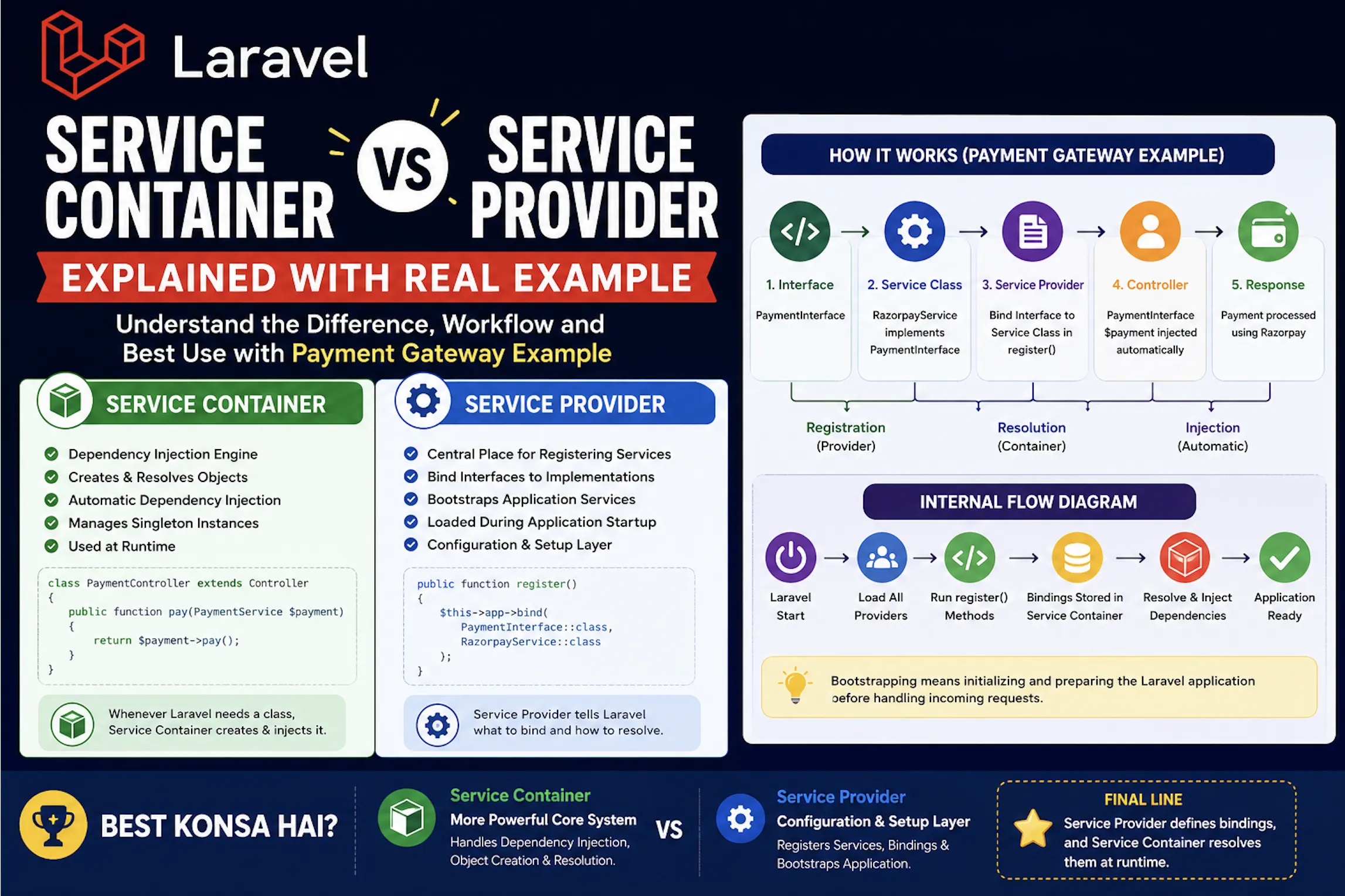
Laravel Service Container is Laravel’s Dependency Injection Engine. It is responsible for creating objects, resolving dependencies, injecting required classes automatically, and managing singleton instances.
In simple words:
Service Container automatically creates and provides required class objects.
Whenever you type-hint a class or interface inside a controller, middleware, service, or command, Laravel automatically resolves and injects that dependency using the Service Container.
For example:
class PaymentController extends Controller
{
    public function pay(PaymentService $payment)
    {
        return $payment->pay();
    }
}
Here Laravel automatically creates the PaymentService object and injects it into the controller method. This complete process is handled by the Laravel Service Container.
What is Laravel Service Provider?
Service Provider is the central place where all application services and bindings are registered.
Laravel loads all providers during application startup.
Service Providers are mainly used for:
- Registering services
- Binding interfaces
- Registering singleton classes
- Loading events
- Registering observers
- Sharing data with views
- Bootstrapping application features
In simple words:
Service Provider tells Laravel what services should be loaded and how dependencies should be resolved.
Real World Example — Payment Gateway System
Now let’s understand everything using a practical Payment Gateway example.
Suppose we want to integrate Razorpay inside our Laravel application using proper architecture.
Step 1 — Create Interface
First we create an interface.
File:
app/Contracts/PaymentInterface.php
Code:
namespace App\Contracts;

interface PaymentInterface
{
    public function pay($amount);
}
This interface defines a contract that every payment service must follow.
Step 2 — Create Payment Service
Now we create the actual service class.
File:
app/Services/RazorpayService.php
Code:
namespace App\Services;

use App\Contracts\PaymentInterface;

class RazorpayService implements PaymentInterface
{
    public function pay($amount)
    {
        return "Paid ₹{$amount} using Razorpay";
    }
}
This class implements the interface and contains actual payment logic.
Step 3 — Create Service Provider
Now we create a Service Provider.
Command:
php artisan make:provider PaymentServiceProvider
Laravel automatically creates:
app/Providers/PaymentServiceProvider.php
Step 4 — Register Binding
Now we bind the interface with the actual service class.
namespace App\Providers;

use Illuminate\Support\ServiceProvider;
use App\Contracts\PaymentInterface;
use App\Services\RazorpayService;

class PaymentServiceProvider extends ServiceProvider
{
    public function register()
    {
        $this->app->bind(
            PaymentInterface::class,
            RazorpayService::class
        );
    }

    public function boot()
    {
        //
    }
}
What Does bind() Mean?
$this->app->bind(
    PaymentInterface::class,
    RazorpayService::class
);
This means:
Whenever someone requests
PaymentInterface, Laravel should provideRazorpayService.
This binding is stored inside the Laravel Service Container.
Step 5 — Register Provider in Laravel
Now we must register the provider inside Laravel.
Open:
config/app.php
Add provider inside providers array:
'providers' => [

    App\Providers\PaymentServiceProvider::class,

],
What Happens Internally?
When Laravel starts, it loads all providers from config/app.php.
Then Laravel executes the register() method of every provider.
During this process:
- Bindings are stored inside the Service Container
- Interfaces are mapped with actual classes
- Singleton services are registered
- Application services become available globally
This complete startup process is called:
What is Bootstrapping in Laravel?
Bootstrapping means preparing the application before handling incoming user requests.
Laravel bootstrapping includes:
- Loading .env
- Loading configuration files
- Loading service providers
- Registering bindings
- Loading middleware
- Loading routes
- Registering events
- Preparing application services
In simple words:
Bootstrapping means initializing the Laravel application completely before serving requests.
Step 6 — Create Controller
Now we create controller.
namespace App\Http\Controllers;

use App\Contracts\PaymentInterface;

class PaymentController extends Controller
{
    public function pay(PaymentInterface $payment)
    {
        return $payment->pay(500);
    }
}
Notice carefully:
PaymentInterface $payment
We are injecting the interface, not the actual class.
Laravel automatically resolves the correct class using Service Container bindings.
Step 7 — Add Route
use App\Http\Controllers\PaymentController;

Route::get('/pay', [PaymentController::class, 'pay']);
Complete Internal Laravel Flow
When user visits:
/pay
Laravel internally performs this process:
Request
↓
Route
↓
Controller
↓
Needs PaymentInterface
↓
Service Container checks bindings
↓
PaymentServiceProvider mapping found
↓
Creates RazorpayService object
↓
Injects dependency
↓
Returns response
Difference Between Service Container and Service Provider
| Feature | Service Container | Service Provider |
|---|---|---|
| Purpose | Resolve dependencies | Register services |
| Main Work | Object creation | Application bootstrapping |
| Usage | app(), resolve(), DI | register(), boot() |
| Handles | Dependency Injection | Service Registration |
| Runtime | Yes | Startup Time |
register() vs boot() in Laravel
register()
The register() method is used for:
- Service bindings
- Singleton registration
- Container mappings
- Dependency configuration
Example:
public function register()
{
    $this->app->bind(...);
}
boot()
The boot() method runs after the application is fully loaded.
It is used for:
- View sharing
- Observers
- Events
- Routes
- Macros
- Runtime initialization
Example:
public function boot()
{
    View::share('appName', 'BharatTodayTech');
}
bind() vs singleton()
bind()
Creates a new object every time.
$this->app->bind(...)
singleton()
Reuses the same object throughout the application lifecycle.
$this->app->singleton(...)
Singleton is useful for:
- Cache managers
- Logger systems
- Payment SDK clients
- API services
Real Project Usage
Laravel Service Container and Service Providers are heavily used in modern Laravel applications including:
- Repository Pattern
- Payment Gateways
- SMS Systems
- Notification Systems
- Queue Systems
- Authentication Drivers
- Third-party API Integrations
- Microservices Architecture
Why Laravel Service Container is Powerful?
Benefits of Service Container:
- Loose coupling
- Better architecture
- Easier testing
- Scalable applications
- Flexible dependency management
- Cleaner code structure
- Better maintainability
Related Laravel & Development Guides
You may also like these helpful development tutorials:
- How to Switch PHP Versions on macOS Using Homebrew
- How to Set Up OpenVPN on Linux Step-by-Step Guide
Laravel Interview Questions
What is Service Container in Laravel?
Laravel Service Container is a powerful dependency injection container used to manage class dependencies and automatically resolve required objects.
What is Service Provider in Laravel?
Service Providers are the central place where all Laravel application services are registered and bootstrapped.
What is Dependency Injection in Laravel?
Dependency Injection means automatically providing required class dependencies into another class using Laravel Service Container.
What is Bootstrapping in Laravel?
Bootstrapping means initializing and preparing the Laravel application before handling incoming requests.
Final Conclusion
Service Provider and Service Container work together inside Laravel.
- Service Provider registers services and bindings
- Service Container resolves and injects dependencies at runtime
The easiest line to remember is:
Service Provider defines bindings, and Service Container resolves them at runtime.
Understanding these concepts properly helps you write scalable, maintainable, and professional Laravel applications.